Partenariat strategique entre un consortium maroco-emirati et des acteurs publics pour le developpement d’infrastructures hydriques et energetiques prioritaires
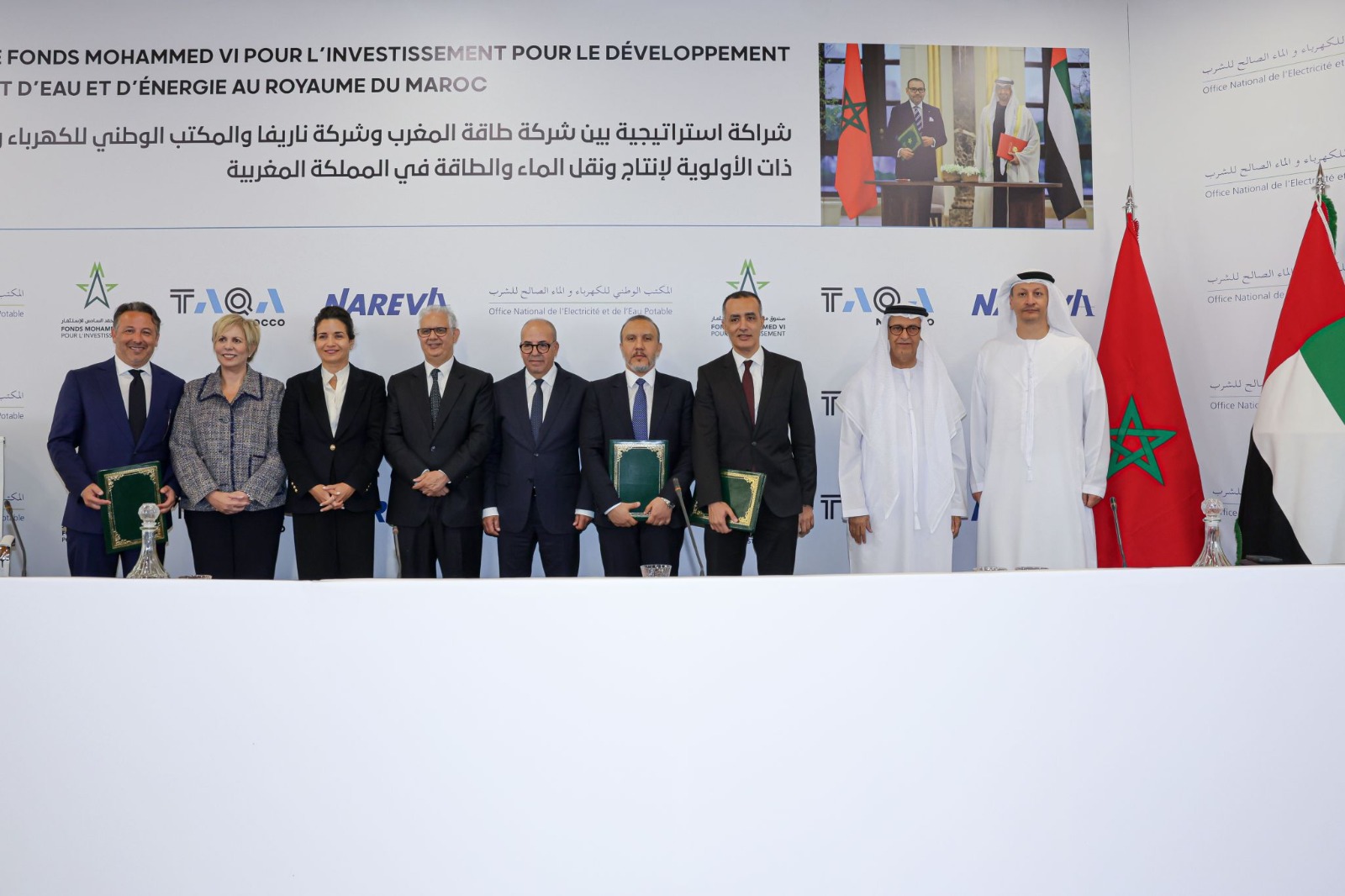
A consortium comprising the Mohammed VI Investment Fund, TAQA Morocco – a subsidiary of the Emirati group TAQA – and NAREVA (the Consortium), has signed three memoranda of understanding with the Moroccan Government and the National Office of Electricity and Drinking Water (ONEE).
"In accordance with the declaration signed on December 4, 2023, between His Majesty King Mohammed VI, may God assist Him, and His Highness Sheikh Mohammed bin Zayed Al Nahyan, President of the United Arab Emirates, calling for an innovative, renewed, and deeply rooted partnership between the Kingdom of Morocco and the United Arab Emirates, and based on the memoranda of understanding signed on the same occasion, a consortium comprising the Mohammed VI Investment Fund, TAQA Morocco – a subsidiary of the Emirati group TAQA – and NAREVA (the Consortium), has signed three memoranda of understanding with the Moroccan government and the National Office of Electricity and Drinking Water (ONEE)", a joint statement indicated.
These memoranda of understanding concern the development of new water and electricity transport infrastructure as well as new seawater desalination capacity and electricity production from renewable sources and natural gas, the same source added.
This investment program falls within the framework of the Kingdom of Morocco's water and energy strategies and aims to enhance both national water security and energy independence and to address urgent and priority needs identified in these areas. It includes the following components:
– Water Transport: Construction of water transfer infrastructure between the Oued Sebou basins and the Oued Oum Rabia basin for a capacity of 800 million m3/year, to combat water stress;
– Desalination: Construction of seawater desalination plants for a total capacity of 900 million m3/year, entirely powered by renewable energy, thus capitalizing on Moroccan innovation in this field. The construction of these plants will enhance the national desalination capacity at a target tariff aligned with the benchmark prices set for desalination projects already underway nationally, not exceeding 4.5 dirhams ex-tax/m3;
– Electrical Transmission: Construction of a 1400 km high-voltage direct current (HVDC) power line connecting the South and Center of the Kingdom for a capacity of 3000 MW, enabling an increase in national transmission capacity and further accelerating the development of renewable energy capacities in the Southern Provinces of the Kingdom. The operation of this line, after commissioning, will be managed by ONEE.
– Renewable Electricity: Development of additional renewable energy capacities of 1200 MW, increasing the volumes of green electricity produced in the Kingdom;
– Thermal Electricity: Development of natural gas-fired combined-cycle power plants at the Tahaddart site for a total capacity of nearly 1500 MW, strengthening the resilience of the national electrical system.
For the development of each project, specific development agreements will be signed between ONEE and the Consortium. In this regard, the first development agreement implementing the project for new combined-cycle power plants in Tahaddart has been concluded.
Financing for this water and energy infrastructure program will be structured by the consortium and raised from national and international financial institutions. Given the strategic importance and urgent context of the projects, the consortium will ensure to gather the best national and international expertise to enable their phased completion by 2030.
The implementation of the program remains subject to the necessary regulatory authorizations and procedures in force, particularly regarding the control of concentration operations.
This structuring investment program constitutes a strategic lever for the country's economic, social, and environmental transformation. It will notably generate the creation of over 25,000 jobs during the construction and operation phases of the projects, including more than 10,000 permanent positions after commissioning.
This program will also promote technology transfer and the emergence of a local industrial ecosystem, particularly in the fields of seawater desalination and renewable energies. It will constitute an opportunity for the development of training sectors and technical expertise related to these key industry sectors.
Ultimately, this structuring investment program will combine water security, energy transition, technological innovation, and economic and social development, while generating a positive impact on employment, competitiveness, and national sovereignty, concludes the statement.